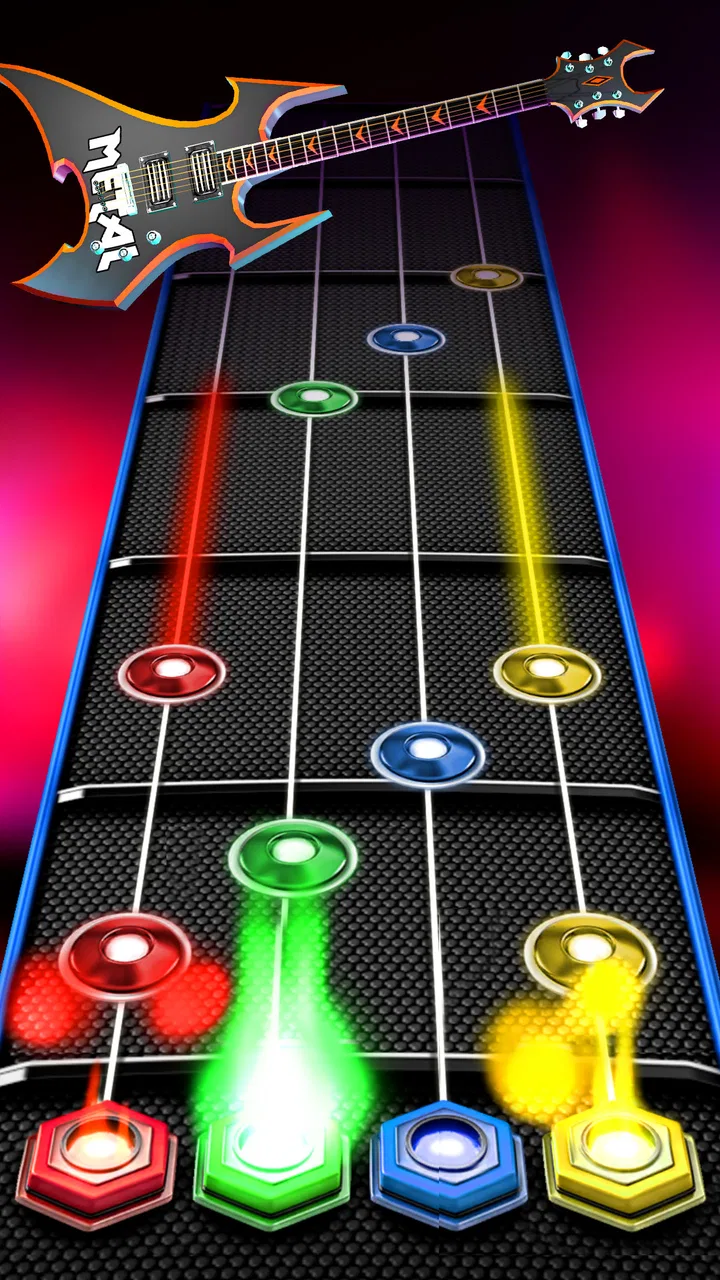
Guitar Band: Rock Battle
- 4.5
- Rating
- 50.00M
- Installs
- Free
- Price

 Analysis by App-foxy
I approached Guitar Band: Rock Battle as a music game first, but its real test is how comfortably it lets different people take part. The basic idea is easy to understand: follow the rhythm, play guitar parts, and work through songs with timing and attention. That makes it immediately appealing to anyone who enjoys music games but does not necessarily play a real instrument.
It is a free game from Supercharge Mobile, rated for Everyone, and it has built a sizeable audience with over 10 million installs. Its average rating sits at 4.2 from around 290 thousand ratings, which suggests a generally positive reception without implying that every player will have the same experience. I found that the strongest part of the game is its quick musical feedback, while the weaker side appears when a player needs especially clear controls, a calmer pace, or fewer interruptions from progression and monetization.
How Guitar Band: Rock Battle feels to use
I found that the game’s key appeal is turning familiar music into a quick, hands-on timing challenge rather than asking you to learn an instrument. That makes it easy to try in a spare moment, though the screen and your fingers need your attention while a song is underway. Next, I’ll look at how that simple idea shapes the feel of a session.
You May Also Like

 AccuWeather: Weather Radar
AccuWeather Review: A Quick, Clear Forecast for Everyday Decisions
For everyday plans, the best forecast is the one you can understand quickly. AccuWeather makes rain timing, radar, and local conditions easy to act on, with a few trade-offs.

 Hill Climb Racing
Why Hill Climb Racing Still Turns Crashes Into One More Run
A tiny car, a bumpy hill and one more upgrade: Hill Climb Racing keeps resurfacing because its simple chaos makes every near-miss feel personal.

 AliExpress - Shopping App
AliExpress Makes Global Shopping Feel Personal, but Shoppers Bear the Risk
AliExpress turns a global marketplace into a pocket-sized discovery engine. Its reach is useful, its shopping loop compelling, and its trade-offs easy to miss.

 Lords Mobile: Kingdom Wars
Lords Mobile Is a Kingdom-Building Routine, Not a Quick Match
A case-by-case verdict on the building, battles, device demands, and social commitments that make Lords Mobile rewarding for some players and exhausting for others.

 PDF Scanner app - TapScanner
TapScanner Makes Paperwork Easier to Capture, Check, and Share
TapScanner makes scanning with a phone feel less like a rescue operation and more like a dependable step in getting work done. Its capture tools are useful, though not flawless.

 Block Blast!
 Shows How Much a Puzzle Game Can Leave Out
A quiet grid game shows why puzzle players increasingly value instant clarity, repeatable skill and low-pressure play—and where the genre still needs to catch up.
More From Our News Desk
View All News


Readability and navigation during play
The game is built around a visual rhythm challenge, so the screen has to communicate several things quickly: where notes are coming from, when they should be played, and how well the timing was judged. In my experience, that makes the first few moments of a song more important than the surrounding menus. Once I understood the visual flow, I could focus on the music instead of wondering what each area of the screen meant.
This is a useful distinction for new players. Someone familiar with rhythm games will probably recognize the basic language quickly, while a person coming from a traditional guitar game may need a short adjustment period. The game presents the fantasy of playing guitar without requiring knowledge of chords or music theory, but success still depends on reading moving prompts and reacting at the right moment.
I would not describe the interface as a replacement for a large-screen music display. On a smaller phone, the active play area can feel busy, particularly when visual effects and note movement compete for attention. A larger screen gives the timing lane more breathing room and makes it easier to keep the next input in sight. That matters for players who rely on visual precision rather than sound to guide them.
Navigation outside a song follows the familiar pattern of choosing music, checking progress, and returning to play. That familiarity helps, although the overall experience is more comfortable when I take a moment to learn where the important controls are rather than tapping quickly through every screen. For a younger player or someone who does not often play mobile games, an initial guided session would be helpful even if the core interaction is straightforward.
The game’s musical presentation also supports orientation. Audio gives context to the visual prompts, and the combination makes successful timing feel more natural than a purely abstract tapping exercise. Still, I would advise players who have difficulty distinguishing small moving elements to use the clearest display available and reduce distractions around the phone. The game’s readability depends not only on its interface but also on the device, lighting, and the player’s distance from the screen.
Motor demands and sensory comfort
The main physical demand is repeated, precise tapping or touching in time with the track. That sounds simple, but rhythm games can be surprisingly demanding because the player must coordinate sight, hearing, and finger movement continuously. A person with quick reactions may find the interaction satisfying; someone with limited dexterity, hand fatigue, tremors, or difficulty performing rapid repeated inputs may find later play much less comfortable.
I appreciate that the concept does not require a physical guitar controller. That removes a cost and a piece of equipment that could be awkward for some users. Playing directly on a phone is more approachable, and it means I can try a short session almost anywhere. The trade-off is that the touchscreen offers no physical landmarks. A player cannot feel a button position or use a tactile reference to prepare the next input, so the experience remains heavily visual.
For players with one-handed use in mind, the phone’s size and the need to maintain a stable grip become important. I found that a supported phone or a flat surface can make short sessions easier than holding the device in midair. This is a small practical change, but it can reduce accidental movement and leave the active hand more relaxed. It also helps avoid turning a timing mistake into a grip problem.
Sound is central to the appeal, but it is not the only route into the game. A player can watch the prompts and use the music as reinforcement rather than depending entirely on hearing. That can make the game more approachable for someone who prefers visual timing. However, anyone who cannot comfortably follow moving visual cues may face the opposite problem, because the game’s core challenge is still based on synchronized perception and action.
Players sensitive to flashing effects, strong contrast, or busy motion should pay attention to how a song feels rather than assuming every track will be equally comfortable. Music games naturally combine movement, color, and sound, and this title is no exception. Taking breaks between songs is sensible, especially when the goal is casual enjoyment rather than a long session. I would also avoid playing in a dark room with the screen at an uncomfortable brightness, since that can make visual fatigue arrive sooner.
Using it in everyday situations
The free entry point makes the game easy to test during a short break. I can imagine opening it while waiting for an appointment, playing one or two songs, and closing it without needing to prepare an instrument or commit to a long practice session. That is where the mobile format works best: the game turns a few spare minutes into a compact music activity.
It is less suitable in places where sound would disturb other people. On public transport, in a shared office, or beside someone who is sleeping, the musical feedback may need to be muted or kept low. The game can still be approached visually, but the loss of audio removes part of what makes the timing feel musical. In a noisy environment, the opposite problem appears: outside sound can make it harder to use the track as a reliable cue.
Screen size and grip also change the experience outside the home. A phone held in one hand while walking is not a sensible setup, because the player needs attention for both the screen and the timing. I would save it for a seated situation where the device is stable. For children, the Everyone rating makes the game broadly approachable, but adults should still consider whether the child can manage rapid touch input and understand any purchase prompts before handing over the phone.
The game is a good fit for a casual player who wants a guitar-themed challenge without learning an actual instrument. It can also suit someone who enjoys comparing personal timing performance across repeated attempts. I would be more cautious recommending it to a player looking for realistic guitar technique, open-ended music creation, or a quiet educational tool. This is a rhythm game built around performance inside its own rules, not a lesson in how to hold, tune, or play a real guitar.
Progression, purchases, and practical friction
Because the game is free, trying it costs nothing at the start. That is a meaningful advantage for families and curious players who want to find out whether the timing style is enjoyable before spending money. The game includes in-app purchases ranging from $0.99 to $299.99 per item, so I would treat purchase awareness as part of the setup, particularly when children use the device.
The presence of optional spending can affect how different players experience progression. Someone happy to repeat songs and improve gradually may be comfortable treating purchases as entirely optional. Another player may feel pressure if progress, customization, or access appears to move more quickly through spending. I recommend deciding in advance whether the game is being used as a free casual pastime or as a hobby worth supporting financially. That simple boundary makes the experience easier to judge on its own terms.
There is also a trade-off between replay value and repetition. Rhythm games are often strongest when a player enjoys refining timing, and this title benefits from that mindset. If I miss a sequence, replaying it can feel like practice rather than failure. But if I want constant novelty without repeating songs or patterns, the format may become less satisfying. The game rewards patience and incremental improvement more than it rewards players who expect every session to feel completely new.
Its current version is 4.16.1, and it supports devices running Android 7.0 or later. That gives the game a broad technical reach, but compatibility alone does not guarantee the same comfort on every phone. Older or smaller devices may make the screen feel more cramped, while newer hardware may provide a smoother and clearer presentation. I would check the available storage and the device’s general responsiveness before committing to long sessions, especially if the phone already struggles with other games.
One practical tip is to begin with short sessions and pay attention to the reason behind each mistake. If the problem is timing, replaying can help. If the problem is that the next prompt is hard to see, changing grip, distance, or screen brightness may help more than playing faster. If the problem is finger fatigue, continuing immediately is unlikely to improve performance. This sounds obvious, but separating visual, motor, and timing difficulties prevents wasted effort.
Who may need another kind of game
I would not choose this as the first option for someone who wants a highly accessible music experience with minimal hand movement. The central interaction still asks for accurate, repeated touchscreen input, and the game’s appeal depends on reacting to a stream of prompts. A slower music app, a turn-based game, or an experience controlled mainly through menus may be a better match for limited dexterity or fatigue.
It may also disappoint players who expect a full guitar simulator. The guitar theme is inviting, but the skills learned here are rhythm and reaction skills rather than transferable fretboard technique. A real guitar, a structured learning app, or a music-making tool would be more appropriate for someone whose goal is to practice chords, scales, finger placement, or songwriting.
Players who need strong tactile feedback should think carefully before choosing it. A physical controller can provide clearer button boundaries and reduce the need to watch every movement. By contrast, a touchscreen rhythm game keeps the player visually engaged at all times. That is not a flaw for everyone; it is simply the main design trade-off that determines who will feel comfortable.
There is a similar distinction for sensory preferences. If you enjoy energetic music, moving graphics, and immediate feedback, the presentation can be motivating. If you are sensitive to visual intensity or prefer a restrained interface, the same qualities may become tiring. I would test a short session at a comfortable brightness and volume before deciding whether it belongs in a daily routine.
My inclusive verdict after playing
Guitar Band: Rock Battle works best when I treat it as a compact, guitar-flavored rhythm challenge rather than a guitar-learning product. The free price, Everyone rating, and simple premise make it easy to recommend as a trial for families, casual players, and music fans who want something they can pick up quickly. Its large audience and 4.2 average show that the formula has broad appeal, while the experience itself explains why: the link between a song and a successful touch is immediate and rewarding.
Its inclusive strengths are practical rather than absolute. It does not require a physical instrument, musical training, or a long setup. Visual prompts can help players who do not want to rely only on sound, and short sessions fit naturally into everyday life. A supported phone, a larger display, sensible brightness, and careful volume choices can make a noticeable difference.
The barriers are just as clear. Rapid touchscreen timing can be difficult for players with motor limitations, fatigue, or a need for tactile controls. Busy motion and loud music may not suit every sensory preference, and a noisy or unstable environment can undermine accuracy. The purchase range also means parents should supervise the financial side instead of assuming that “free” describes every possible part of the experience.
My recommendation is strongest for someone who wants an accessible starting point for rhythm games, enjoys replaying songs to improve, and is comfortable using a screen as the main instrument. I would skip it for anyone seeking genuine guitar instruction, low-stimulation interaction, or controls that can be operated without constant visual attention. For the right player, it turns a phone into a lively little performance space; for everyone else, its limitations are visible early enough to make an informed choice.
FAQs for Guitar Band: Rock Battle
01What platforms is Guitar Band: Rock Battle available on?
Guitar Band: Rock Battle is available on both Android and iOS platforms. You can download it from the Google Play Store or the Apple App Store, making it accessible to a wide range of mobile users. Ensure your device meets the app’s system requirements for an optimal experience.
02Does Guitar Band: Rock Battle require an internet connection?
Yes, Guitar Band: Rock Battle requires an internet connection to access certain features such as online competitions, leaderboards, and social interactions. While some gameplay modes might be available offline, the full experience, including updates and community activities, necessitates a stable internet connection.
03Are there in-app purchases in Guitar Band: Rock Battle?
Guitar Band: Rock Battle offers in-app purchases that allow players to buy virtual currency, unlock premium content, or enhance their gameplay experience. Although the game is free to play, these purchases can provide advantages or cosmetic upgrades, so it’s important to monitor spending if children are playing.
04How beginner-friendly is Guitar Band: Rock Battle?
Guitar Band: Rock Battle is designed to be accessible to players of all skill levels. It features tutorials and an easy mode for beginners, while offering more challenging levels for experienced players. This makes it a great choice for both newcomers to rhythm games and seasoned players looking for a challenge.
05Can I play Guitar Band: Rock Battle with friends?
Yes, Guitar Band: Rock Battle includes multiplayer features that allow you to compete against friends in real-time battles. You can connect with friends through social media or find new opponents online, providing a dynamic and social gaming experience that enhances replayability.
Pros
- Impressive graphics and sound quality.
- Wide range of songs to master.
- Engaging multiplayer mode.
- Customizable guitar options.
- Regular updates with new content.
Cons
- In-app purchases can be pricey.
- Requires internet for some features.
- Occasional ads disrupt gameplay.
- Limited offline song options.
- High battery consumption during play.

Guitar Band: Rock Battle
Gallery